Introduction
Deadlifting is one of the most powerful and effective strength exercises you can do. It builds full-body strength, improves posture, boosts athletic performance, and carries over into everyday movements like lifting groceries or picking objects off the floor. Despite its benefits, the deadlift is often misunderstood or performed incorrectly, leading to stalled progress or injury.
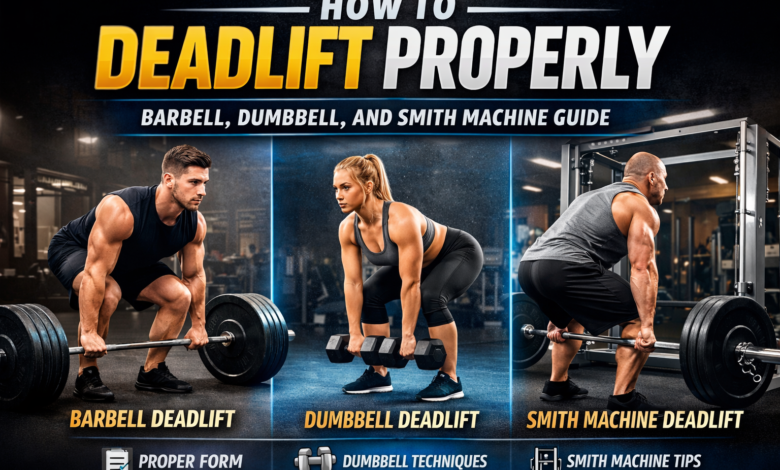
This guide walks you through how to deadlift, how to deadlift properly, how to deadlift with dumbbells, and how to deadlift on a Smith machine—step by step, equipment by equipment. Whether you’re a beginner or refining your technique, this article will give you the clarity you need.
How to Deadlift
The deadlift is a compound movement where you lift weight from the ground to a standing position using your hips and legs, while keeping your spine stable. Unlike many gym exercises, the deadlift mirrors real-life movement patterns, which is why it’s often called a “functional” lift.
What Is a Deadlift?
At its core, the deadlift is a hip hinge, not a squat. Your hips move backward while your knees bend slightly, allowing your torso to lean forward without rounding your back. The goal is to lift the weight by driving through your heels and extending your hips—not pulling with your arms.
Deadlifts can be performed using various equipment:
- Barbell
- Dumbbells
- Smith machine
-
Kettlebells or trap bars
Each version has its own benefits and learning curve, but the fundamental movement remains the same.
Muscles Worked During a Deadlift
Deadlifts recruit multiple muscle groups at once, making them incredibly efficient.
The primary muscles involved include the glutes, hamstrings, and quadriceps. Secondary muscles include the lower back, core, lats, traps, and forearms. Because so many muscles are working together, deadlifts also stimulate hormonal responses that support muscle growth and strength gains.
Benefits of Deadlifting
Deadlifting isn’t just about lifting heavy weights—it’s about building a stronger body overall.
Some of the biggest benefits include improved posture, stronger posterior chain muscles, enhanced grip strength, better athletic performance, and increased calorie burn due to high muscle engagement.
Learn how to deadlift safely and effectively to build full-body strength, improve posture, and reduce injury risk with proper technique.
How to Deadlift Properly
Learning how to deadlift properly is far more important than how much weight you lift. Proper form ensures safety, efficiency, and long-term progress.
Proper Deadlift Setup and Stance
Your setup determines the success of your lift before the weight even leaves the ground.
Stand with your feet hip-width apart, toes pointing slightly outward. The barbell or weight should be positioned over the middle of your foot, not your toes. This alignment allows for balanced force production during the lift.
Your shins should be close to the weight, but not pushing it forward. A stable stance creates a solid base and prevents unnecessary strain.
Correct Deadlift Grip and Hand Position
Grip the weight just outside your knees. Your arms should hang straight down, acting as hooks rather than pulling muscles.
Grip strength matters, but your back position matters more. Keep your shoulders slightly in front of the weight and your chest open. Your hands should remain neutral, without excessive wrist bending.
Step-by-Step Deadlift Form
To perform a proper deadlift, follow this controlled sequence:
- Brace your core as if preparing for a punch
- Push the floor away with your feet
- Extend your hips and knees together
- Keep the weight close to your body
- Stand tall without leaning backward
At the top of the movement, your hips should be fully extended, shoulders stacked over hips, and core engaged. Avoid shrugging or hyperextending your lower back.
Common Deadlift Mistakes to Avoid
Many deadlift injuries come from repeated poor habits rather than one heavy lift.
Common issues include rounding the lower back, lifting with the arms, letting the bar drift away from the body, and jerking the weight off the floor instead of lifting with control.
Fixing these mistakes often requires reducing the weight and rebuilding technique—an investment that pays off quickly.
Deadlift Safety Tips and Cues
Breathing and bracing are critical. Inhale deeply before lifting, brace your core, and exhale once the weight passes your knees or at lockout. Think of your torso as a solid cylinder supporting the movement.
How to Deadlift With Dumbbells
Dumbbell deadlifts are an excellent option for beginners, home workouts, or anyone working on balance and unilateral strength.
Dumbbell Deadlift Setup
Hold one dumbbell in each hand, arms at your sides. Stand tall with feet hip-width apart. Unlike barbell deadlifts, dumbbells allow a more natural range of motion and reduce stress on the lower back.
Proper Dumbbell Deadlift Form
Lower the dumbbells by pushing your hips back while keeping your chest up. The weights should track close to your legs as you descend. Once you feel a stretch in your hamstrings, reverse the movement by driving your hips forward.
Because dumbbells are independent, they help expose strength imbalances between sides.
Romanian vs Conventional Dumbbell Deadlift
The Romanian dumbbell deadlift emphasizes hamstrings and glutes by limiting knee bend and increasing hip hinge depth. Conventional dumbbell deadlifts involve more knee bend and allow the weights to reach the floor.
Choosing between the two depends on your training goals and mobility.
Common Dumbbell Deadlift Mistakes
Using dumbbells doesn’t eliminate the risk of poor form. Common errors include squatting the movement, rounding the back, and letting the dumbbells drift too far forward.
Dumbbell deadlifts are perfect for beginners, improving balance, fixing muscle imbalances, and learning proper hip hinge mechanics safely.
How to Deadlift on a Smith Machine
Smith machine deadlifts are often debated, but they can be useful when applied correctly.
Smith Machine Deadlift Setup
Position your feet slightly forward compared to a barbell deadlift. The fixed bar path changes mechanics, so foot placement is key. Start with lighter weights to learn the movement.
Proper Smith Machine Deadlift Form
Grip the bar just outside your legs. Keep your spine neutral and focus on hip extension rather than pulling the bar. Because the bar path is fixed, concentrate on moving your body correctly around it.
Smith Machine Deadlift Pros and Cons
Smith machines provide stability and reduce balance demands, making them useful for beginners or rehabilitation. However, they limit natural movement patterns and may not fully engage stabilizer muscles.
Common Smith Machine Deadlift Mistakes
Relying too heavily on the machine’s support can lead to poor transfer to free weights. It’s best used as a tool—not a replacement for barbell training.
Deadlift Variations and Progressions
Different deadlift styles exist to accommodate body types, goals, and experience levels.
Barbell vs Dumbbell vs Smith Machine Deadlifts
| Equipment Type | Best For | Key Advantage | Limitation |
|---|---|---|---|
| Barbell | Strength & power | Maximum load potential | Requires good technique |
| Dumbbells | Beginners & home workouts | Balance and mobility | Limited weight |
| Smith Machine | Controlled training | Stability and safety | Restricted movement |
How to Progress Your Deadlift Safely
Progress doesn’t always mean adding weight. Improving tempo, increasing reps, refining form, or adding pauses can all drive growth without increasing injury risk.
Frequently Asked Questions About Deadlifting
How Much Weight Should Beginners Deadlift?
Beginners should start with a weight that allows perfect form for 8–10 reps. This might be an empty barbell, light dumbbells, or even bodyweight hinge practice.
How Often Should You Deadlift?
Most people benefit from deadlifting once or twice per week. Recovery matters just as much as training intensity.
Conclusion: Mastering the Deadlift for Long-Term Strength
Deadlifting is more than a gym exercise—it’s a foundational movement that builds strength, confidence, and resilience. Whether you choose barbells, dumbbells, or the Smith machine, mastering proper technique is what unlocks the real benefits.
Focus on form first, progress patiently, and choose the variation that fits your experience level and goals. With consistency and attention to detail, deadlifts can become one of the most rewarding movements in your training routine.
Master how to deadlift properly using barbells, dumbbells, or Smith machines to build strength, stay safe, and train with confidence.
Read More:- Japanese Weight Loss Drink Recipe for Fast & Natural Fat Burning